AI Visibility Reporting Template for Consulting Firms
A copyable weekly AI visibility report for consulting firms, with prompts, citations, competitors, evidence, trends, owners, and next actions.
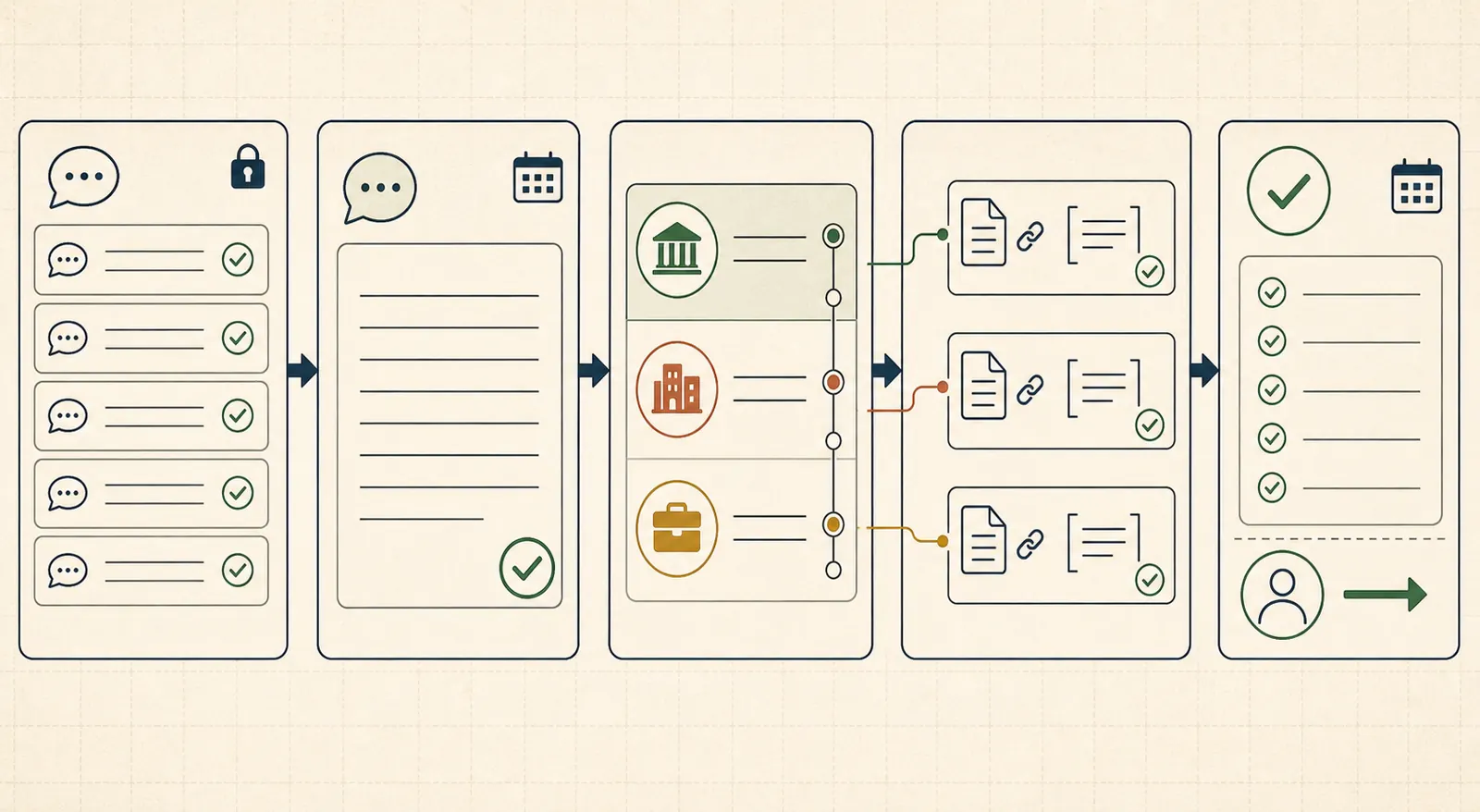
An AI visibility report should be a dated evidence ledger, not one opaque score. It should show the fixed prompt set, the engines checked, whether the firm appeared, which sources were cited, which competitors were mentioned, and where the answer placed each firm. It should also preserve evidence URLs or screenshots, record changes since the last run, and assign one next action to an owner. Keep the method stable between runs. Otherwise, a change in the report may reflect a changed test rather than changed visibility.
Our view: a report should let another person reproduce the finding, not merely trust the score.
For the page-level implementation checklist, see how to optimize a website for AI search.
Key takeaways
- Report prompt-level evidence before any summary metric.
- Separate a brand mention from a citation to a source the firm controls.
- Use the firm's first stable run as a baseline. There is no universal “good score.”
- End each finding with one action, one owner, and one review date.
What should an AI visibility report prove?
A useful report should prove what an AI assistant returned under recorded conditions. A partner, marketer, or analyst should be able to answer four questions:
- What did we ask?
- Where and when did we ask it?
- What appeared in the answer, and what evidence supports that reading?
- What will we do next?
This makes the report auditable. It also limits overclaiming. AI answers can vary by engine, date, location, account state, and prompt wording. A report is therefore a record of observations, not a permanent verdict on the firm's reputation.
Start with the prompt rows. Then summarize them with counts or rates if those summaries help a decision. HubSpot's overview, checked on 21 August 2026, describes AI visibility scores as aggregations of signals such as mentions, citations, and positioning, while also noting that methods differ by platform (HubSpot). That is why a report should expose the evidence beneath any score.
The baseline is specific to the firm, prompt set, engines, and run conditions. Compare like with like over time. Do not label a percentage “good” without context. A specialist consultancy with 20 narrow buying prompts should not inherit a benchmark from a consumer brand tested across hundreds of broad questions.
Which fields belong in the template?
The template needs enough detail to reproduce a finding without becoming a data dump. On pages checked on 21 August 2026, WebTrek's reporting template used five sections—a snapshot header, KPI scorecard, page-level breakdown, gap classification summary, and action items (WebTrek)—while Wellows framed agency reporting as a repeatable checklist rather than a single dashboard number (Wellows). For a consulting firm, the following fields form a practical minimum.
Copyable AI visibility report template
Copy this table into a spreadsheet, database, or client report. Use one row per prompt and engine combination.
| Run date | Prompt ID | Prompt | Intent | Engine | Firm appeared? | Answer position | Firm-owned source cited? | Cited source URL | Other source cited | Competitors mentioned | Evidence URL or screen | Change from prior run | Finding | Next action | Owner | Due date |
|---|---|---|---|---|---|---|---|---|---|---|---|---|---|---|---|---|
| YYYY-MM-DD | P01 | [Exact prompt text] | Problem / category / comparison / firm | [Engine] | Yes / No | First / middle / last / unclear | Yes / No | [URL or blank] | [URL or blank] | [Names or none] | [Link] | New / gained / lost / unchanged | [One sentence] | [One task] | [Name] | YYYY-MM-DD |
| YYYY-MM-DD | P02 | [Exact prompt text] | [Intent] | [Engine] | Yes / No | First / middle / last / unclear | Yes / No | [URL or blank] | [URL or blank] | [Names or none] | [Link] | New / gained / lost / unchanged | [One sentence] | [One task] | [Name] | YYYY-MM-DD |
Add a short run header above the table:
- Report period: start date to end date
- Run conditions: engines, location, account or logged-out state, and device or interface
- Prompt set version: a fixed name such as \`Consulting-Core-v1\`
- Previous comparable run: date and link
- Method changes: none, or a precise note
- Evidence folder: one stable location for screens and exports
The summary can then show total prompts checked, prompts with a firm mention, prompts with a firm-owned citation, and prompts with competitor mentions. Explain each denominator. For example, “firm cited in 3 of 20 checked prompt-engine rows” is clearer than “citation score: 15.” If you use share of voice, define it in the report and link to the fuller guide on AI share of voice.
On its page checked on 21 August 2026, Semrush recommended combining visibility trends with query, source, and competitor detail in AI search reporting (Semrush). The important part is not the volume of charts. It is the chain from observation to evidence to action.
How do you keep the prompt set stable?
Create a named prompt set and version it. Each prompt should represent a question that a plausible buyer, referral partner, or candidate might ask. Keep the exact wording unchanged during routine runs.
A balanced consulting prompt set may cover:
- Problem prompts: “How can a regional bank reduce onboarding delays?”
- Category prompts: “Which firms advise banks on onboarding operations?”
- Comparison prompts: “Compare specialist and large consulting firms for onboarding transformation.”
- Firm prompts: “What is [Firm] known for?”
- Evidence prompts: “Which consultancies have published case studies on onboarding transformation?”
Do not quietly replace a prompt because its wording feels imperfect. Mark it for the next version, preserve the old set, and record the change. Run the old and new versions together once if you need continuity.
Also keep engine selection and run conditions stable where practical. If an engine, interface, or account state changes, note it. The goal is not laboratory certainty. The goal is to make material changes visible so readers do not confuse a method change with a market change.
For a fuller operating rhythm, see AI visibility monitoring. The reporting layer should draw from that routine, not invent a new method each week.
What counts as a citation versus a mention?
A mention occurs when the answer names the consulting firm. A citation occurs when the answer links or attributes a claim to a source. The source may belong to the firm, a publisher, a directory, a client, or another third party.
Record these separately:
- Firm mention: the firm is named in the answer text.
- Firm-owned citation: the answer cites a page on the firm's controlled domain.
- Third-party citation about the firm: the answer cites an independent page that discusses the firm.
- Unlinked attribution: the answer names a source but provides no usable link.
- No citation: the answer makes the statement without visible sourcing.
This distinction matters. A firm can be mentioned without receiving a citation. Its article can be cited without the firm being recommended. A third-party profile can support a mention without sending readers to the firm's site.
Capture the exact source URL when visible. If the interface hides sources behind a panel, preserve a screen and note how the source was opened. Do not infer that a page influenced an answer merely because it ranks in search or covers the same topic.
Jungle Roots has one dated example of this evidence standard. Its public proof wall records a Perplexity baseline dated 3 July 2026 with 2 cited answers out of 18 observed prompts. That result belongs only to that run. It is not a benchmark, a general visibility rate, or a promise about later answers.
How should you report competitors?
Report competitors at the prompt level before calculating a roll-up. List which firms appeared, where they appeared in the answer, and whether they had a citation. This avoids treating every mention as equal.
Use neutral labels such as:
- named before the firm
- named after the firm
- included in a shortlist
- recommended for a stated use case
- mentioned without supporting evidence
- cited through a firm-owned page
- cited through a third-party page
Do not convert one answer into a claim that a competitor “owns” a topic. Look for repeated patterns across comparable runs. If one firm appears often for a narrow intent, inspect the cited sources and the language used to describe its expertise. That evidence can guide content, proof, and distribution work.
A competitor section should answer “what can we learn?” rather than “who won?” Useful notes include missing proof formats, clearer service language, stronger third-party coverage, or a source that appears across several answers. Avoid guessing at the cause when the evidence only shows correlation.
Which actions follow each finding?
Every material finding should lead to one bounded action. The action should address the evidence in the row, not a vague goal to “improve AI visibility.”
| Finding | Sensible next action |
|---|---|
| Firm is absent, and competitors are cited through detailed service pages | Review whether the firm's relevant service page answers the prompt and supports its claims |
| Firm is mentioned, but no firm-owned source is cited | Create or strengthen a source page with clear evidence, authorship, and direct answers |
| Third-party pages drive the firm's mentions | Verify accuracy, then identify ethical ways to keep those profiles current |
| Competitor is repeatedly cited for a case study | Publish an approved case study or proof page that addresses the same buyer need |
| A firm-owned article is cited, but the firm is not named | Clarify the connection between the expertise, author, service, and firm |
| Visibility changed after a method change | Re-run under comparable conditions before taking content action |
| No pattern is clear | Collect another comparable run instead of forcing a conclusion |
Prioritize actions by buyer relevance, evidence strength, effort, and ownership. Many findings will lead to familiar work: improve a service page, publish proof, clarify entity information, earn credible third-party coverage, or fix an inaccurate source. AI visibility reporting helps select and verify that work. It does not replace sound positioning or editorial judgment.
For definitions that can support the summary, use the guide to AI visibility metrics. To see how Jungle Roots presents recorded examples, See the proof wall.
How do you present the report to a consulting partner?
Lead with decisions, then show the evidence. A partner usually needs a short account of what changed, why it may matter, and what requires approval. They do not need a tour of every dashboard.
Use a five-part briefing:
- Scope: the prompt set, engines, date, and any method changes.
- Material movement: gained, lost, or unchanged findings that affect priority buyer questions.
- Evidence: two or three prompt rows with direct screens and cited URLs.
- Interpretation: what the evidence supports, plus what it does not prove.
- Decision: the next actions, owners, due dates, and any partner approval needed.
Keep the appendix available. If a partner challenges a finding, open the exact prompt row and evidence rather than defending an abstract score. This builds confidence because the limits are visible.
Avoid a red, amber, green label unless the thresholds were agreed in advance. A baseline and trend are more honest than a generic “good score.” Early runs may reveal more about the measurement system than about the firm's actual position. State that plainly.
Weekly AI visibility reporting checklist
- [ ] Use the approved prompt set and version.
- [ ] Record the run date, engines, location, and account state.
- [ ] Save one row for every prompt-engine check.
- [ ] Mark firm mentions and citations separately.
- [ ] Copy each visible cited-source URL.
- [ ] Record competitor names and answer position.
- [ ] Save evidence screens or shareable evidence URLs.
- [ ] Compare only with a methodologically compatible prior run.
- [ ] Explain additions, removals, and changed run conditions.
- [ ] Write one finding per material pattern.
- [ ] Assign one next action, owner, and due date.
- [ ] Review the summary against the underlying rows.
- [ ] Archive the report and evidence with a stable link.
Turn the template into an operating habit
The best template is the one a team can run consistently and audit later. Fix the prompt set. Record the conditions. Preserve the evidence. Separate mentions from citations. Compare compatible runs. Then turn each supported finding into an owned action.
That approach gives a consulting partner something more useful than a mysterious score: a clear record of what appeared, what changed, what remains uncertain, and what the firm will do next. For dated examples of how Jungle Roots records evidence, See the proof wall.
Written by Tileo, an operator who measures how AI assistants cite brands, on his own portfolio first.
What are the frequently asked questions?
What is an AI visibility report?
An AI visibility report records whether and how a brand appears in answers from selected AI assistants. A useful report includes exact prompts, engines, dates, mentions, citations, competitors, evidence, changes, and next actions. It should preserve enough detail for another person to reproduce the check.
How do you measure AI visibility?
Run a fixed set of relevant prompts across selected engines and record results at the prompt level. Track brand mentions, firm-owned citations, third-party citations, answer position, competitor mentions, and evidence. Summaries such as mention rate or share of voice can help, but their definitions and denominators should remain visible.
What is a good AI visibility score?
There is no universal good score. Results depend on the firm, market, prompt set, engines, date, and measurement method. Establish a documented baseline, then examine trends across comparable runs and the buyer relevance of the prompts where movement occurs.
How often should AI visibility be reported?
Weekly reporting suits teams actively changing content, proof, or distribution and gives them a regular decision rhythm. A slower cadence may suit firms with fewer changes. Choose a cadence the team can execute consistently, and avoid drawing conclusions from runs made under different methods.
What is the difference between AI visibility and SEO rankings?
SEO rankings describe positions in search results for queries. AI visibility describes how a firm, its sources, and its competitors appear inside generated answers under recorded conditions. Search visibility may contribute to discovery, but an AI answer is not a conventional ranked list, so the report needs answer-level evidence.
Can an AI visibility report prove why a firm was cited?
No. It can document that a citation appeared and identify the visible source. It can also reveal patterns across prompts and runs. It cannot prove the model's internal reason for choosing a source. Treat explanations as hypotheses to test, not facts.
Related reading